



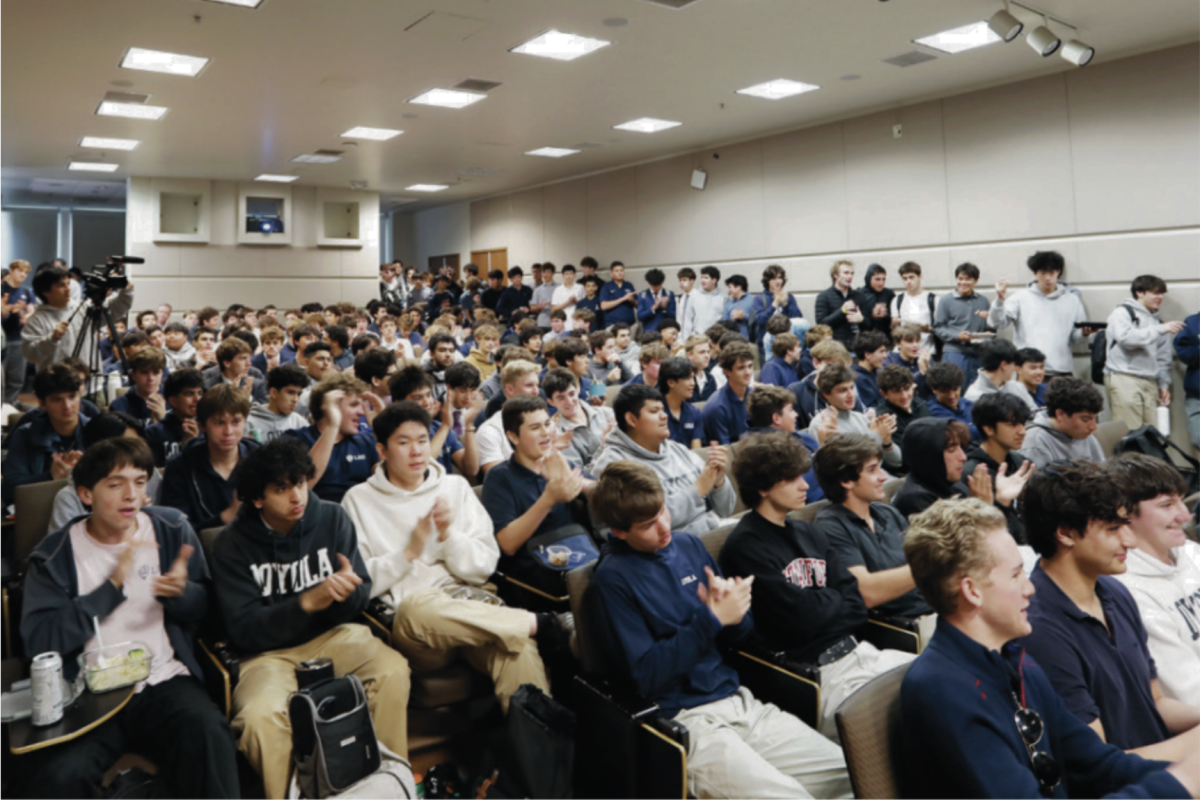
On March 4th, Otero Lecture Hall suddenly became crowded with every seat filled and students lining up against the back walls. The usual chatter was replaced with a heavy, expectant silence for the upcoming event, where a group of students from all sides of the political spectrum engaged in a “Critical Conversation” aimed at answering one question: “Why is there so much distrust in the government today?” Guided by James Zucker ’91, head coach of Loyola’s Speech and Debate program and AP World/European History teacher, the event and its mass turnout reflected the heightened tensions surrounding political discussion. The event hoped to mitigate these circumstances while maintaining civil discussion and active listening among all participants.
Zucker explained, “When we need to express our differences, there’s a correct way to do so. Today we’re going to do this by listening to each other with care. Honestly expressing our differences, but doing it in a way to really understand where our opponents are coming from. And then finally, our main goal behind all of this is to make sure we go out and make the world a better place.”
Representing the conservative position, Jason Gabriel ’28 and Jack Hannon ’28 of Club Freedom argued that distrust is a natural virtue of American democracy. Rather than being a recent development, the Founding Fathers instilled a fundamental skepticism in the foundations of American society to sustain the electorate’s ability to check back against the federal government. Following this logic, they stated that distrust is necessary for a healthy democracy to remain functioning at its best.
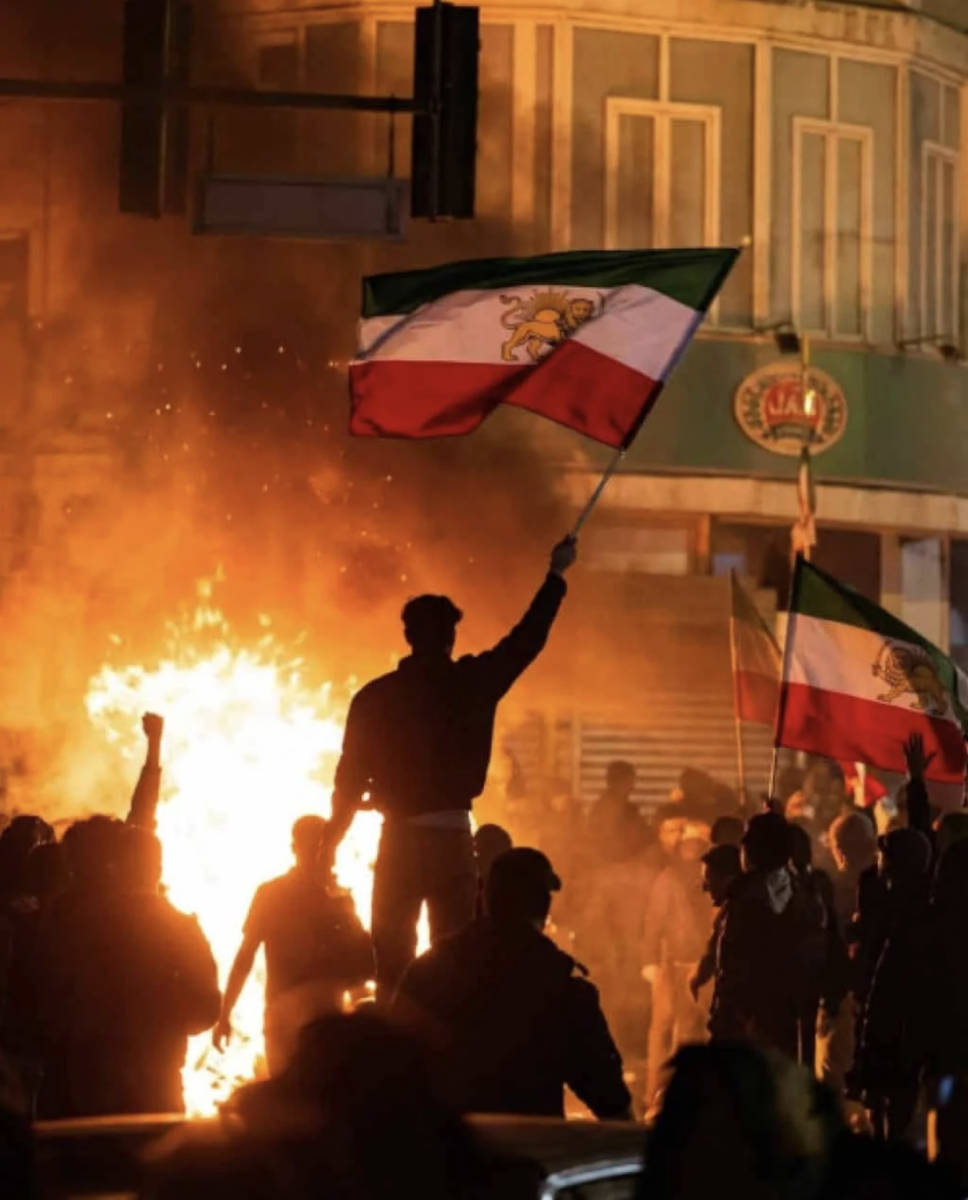
On the opposite end of the aisle, members from the Loyola Left Club, Ethan Dumper ’27 and Jacob Friedman ’26, held that capitalism lay at the heart of distrust of authority, believing that a government created by and for the elites rather than the common person can never gain complete trust from its citizens. Similar to Club Freedom, Jacob Friedman outlined how the roots of capitalism are traceable back to the Founding Fathers and the foundations of the United States. They applied this thesis to the current military intervention in Iran, stating that despite being massively unpopular among the American population, forces of capital have both instigated the conflict and kept politicians from speaking out.
With the majority of the focus on the tension between representatives of the Loyola Left and Club Freedom, seniors Adrian Macias ’26 and Jack Musitano ’26 represented those in the middle of the political spectrum and gave another perspective on this issue. The centrist speakers posited that political polarization—ideological division into two sharply contrasting belief systems—was the heart of current political tension. Citing incidents from both the left and right where politicians would not agree on basic premises of American civil liberty and social welfare, Macias and Mustiano argued that these politicians only opposed these statements because they came from the opposing party.
The discussion format began with each side introducing their core thesis, responding to opponents and finally answering questions from the audience. Distinctively, a segment of “steel-manning” was also included to further ensure that the goal of meaningful deliberation was accomplished. Steel-manning is the practice of reexpressing an opponent’s argument accurately in order to foster honest debate. During the debate, members from each side had to rearticulate another party’s position in its most persuasive form. For instance, Dumper successfully walked the audience through Club Freedom’s position, acknowledging that the bureaucratic structure of the government lends itself to skepticism and questioning from citizens.
The forum was arranged by Zucker in light of the ongoing issues facing political dialogue he and many other members of the Loyola community saw. Students particularly appreciated the opportunity for their peers to come together and share different opinions. Kyle Oh ’27 commented, “Events like these are especially important at a time when technology and social media have clouded genuine political engagement. Instead of having meaningful dialogues where people try to get to know the other position, there are really only monologues from each side talking over one another.”
In this way, forcing individuals to directly grapple with opposing political opinions reduces the effects of echo chambers—the tendency for individuals to be exclusively exposed to opinions and beliefs that reinforce their own—and polarization on the current political landscape. Many modern digital problems have inhibited our ability to disagree with others without resorting to dehumanizing one another. Thus, the existence of educated discourse from both sides of the aisle is pertinent in generating a new landscape of civil debate.
However, some students criticized the event for lacking the necessary clash between the sides, instead of what was perceived as surface-level interaction. Tomas Gonzalez ’26 said, “The goals of ‘Critical Conversations’ would have been better served as a straightforward debate since confrontation is essentially the pinnacle of political discussion. Instead, I saw the right, represented by Club Freedom, not having to defend their positions against much pushback from the left and vice versa.”
This constructive pushback demonstrates that, despite providing an accessible medium for political discussion, Critical Conversations is far from being the perfect solution to a deeply structural challenge facing discourse. With responses from the community being widely varied, plans for future student panels will be sure to incorporate feedback to ensure that goals are effectively met. While there is not a specific date set for a future conversation, discussions are in the works to incorporate feedback from the teachers and student body. Ultimately, the Loyola students must engage in thoughtful dialogue, learn from diverse perspectives and actively seek collaboration and compromise rather than hostility for any sustained change to be accomplished.