



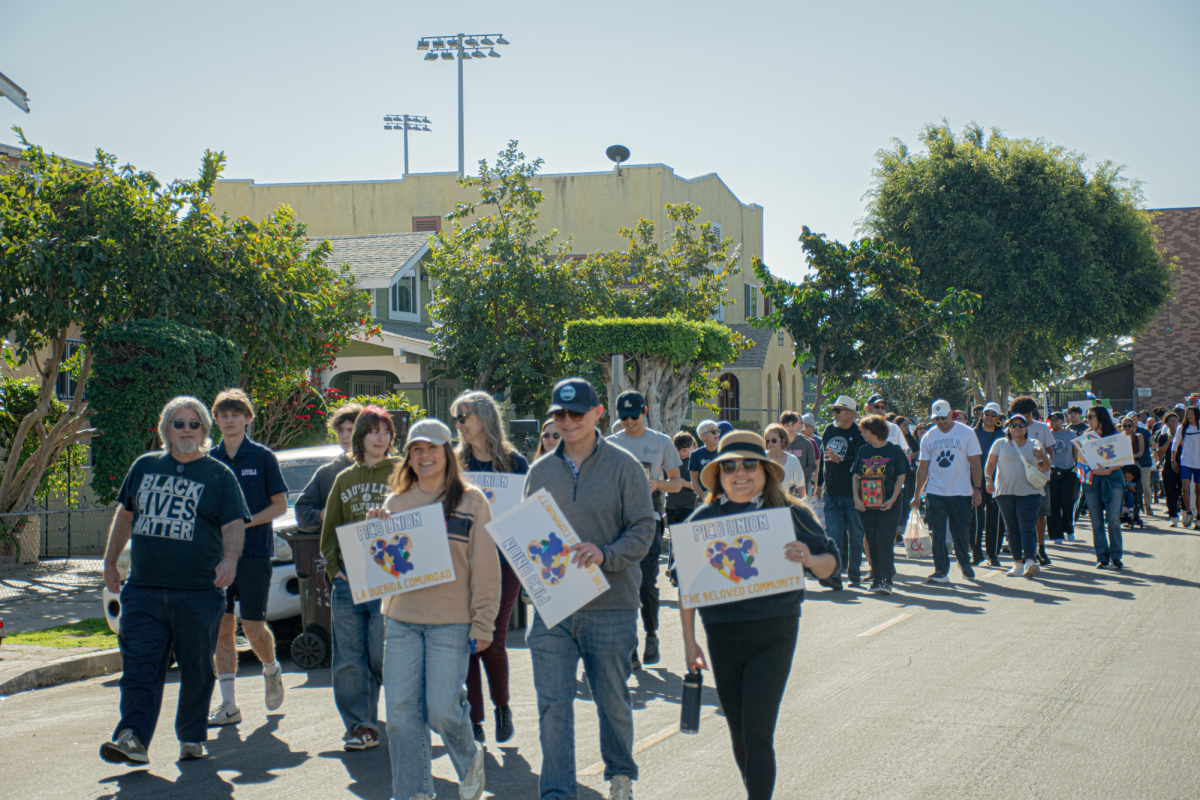
On Martin Luther King Jr. Day, Loyola and the Pico Union community came together to celebrate the incredible civil rights activist through a community march in his name, starting at 1901 Venice Blvd. and ending in front of the Pico Union Branch Library. Marchers passed through the gates of Loyola High School and primarily proceeded down Pico Boulevard, passing local shops and restaurants along the way. The atmosphere of the march was spirited and lively, yet the gravity of the event was apparent. The marchers, led by police escorts, spoke out as communities of color have been terrorized across the nation. The march was an adamant celebration of the vibrant Pico Union community that, instead of omitting conversation about ICE, embraced radical advocacy.
The event, primarily created and managed by Loyola’s Director of Diversity, Equity, and Inclusion, Douglas Brown, centered on MLK Jr.’s ideal society, known as the “Beloved Community,” to further connect Loyola and its surrounding community in solidarity. It drew hundreds, from local congresspeople to Loyola families to residents of Pico Union. Before the march, local volunteer organizations that collaborated with students for their senior service projects, such as LA Voice, hosted a symposium with march attendees.
Tomas Gonzalez ‘26, a volunteer at LA Voice, said, “The goal of [LA Voice] is to advocate for social change for marginalized people. A member of the organization delivered a speech [at the march] about the conditions in her community with ongoing ICE involvement. The event inspired me to look for more opportunities for civic engagement.”
The festivities kicked off with a speaker series in front of Loyola Hall and featured Loyola President Jamal Adams, Center for Service and Justice Head Gabriela Gordillo-Banuelos, and a variety of OEI student leaders. The speakers highlighted the importance of Martin Luther King Jr.’s influence on nonviolent protest and explained the importance of carrying that flame of nonviolence forward, specifically through the spirit of service that Loyola encourages.
Loyola Principal Paul D. Jordan ‘88, speaking about Loyola’s relationship with service, stated, “I think the reason that we have you guys do service and do the senior project is to expose you to different issues and make you a little uncomfortable and kind of get you aware of things, and hopefully, as a result of that, you develop advocacy in terms of your intentionality […] It’s one thing to do service, but it’s another thing to take it to another level and become advocates for the disadvantaged and the poor, the marginalized, and develop plans, and hopefully, we’re weaving in that desire to help others, as you move past Loyola… This is taking that into a lifetime of service, which is the ultimate goal for us.”
Brown explained, “We did want to make the community feel safe. So to have a presence like this, where community members really help the community feel safe and protected. By shutting down the streets, a calm police presence really helps them know that they can trust and be a part of the community.” These connections to the community and the trust that comes with it are not just at the administrative level with teachers and staff, but truly run deep in the Jesuit identities being formed here at Loyola.
Brown and Jordan’s speeches served as role models for the broader Loyola community, demonstrating how to engage with the Pico Union community with dignity and understanding. On the individual scale, students and people in the Los Angeles area have been inspired by this rhetoric to get involved with this mission.
Roberto Gonzales ‘27, a current Loyola junior involved with the Center of Diversity, Equity, and Inclusion led by Brown, commented on the importance of the event, especially to students, stating, “A lot of people came over here for this event, so what I see is that a lot of people do want to participate, a lot of people see that it’s a great idea to do during MLK. And especially that it’s a march, it’s also a pretty significant thing here. I like what [Brown’s] doing here, and hopefully this will be a common tradition we have here at Loyola.”
Loyola students had a prominent role in organizing the march, including Calli Earley ‘26, who worked to create informational posters and presentations for the event, and added that the march was “to support Pico Union’s community, the local businesses.”
In an attempt to allow marchers to support local businesses, Earley said, “This march is designed as a ‘Buy-cott’ […] people are invited to buy from the local businesses. A lot of these businesses are family-owned, small shops [the interview briefly paused as cars honked in support], and all of the owners are incredibly nice.” Earley continued, “During my senior service project, every business we engaged with wanted to share this experience with us, and it was definitely a sign of community strength.”
Additionally, the event showcased local talent across Pico Union. Verbum Dei Jesuit High School, a consistent partner school of Loyola, sent a large delegation to support the event. Mike Sonksen, a poet and English teacher at Verbum Dei, brought two of his star students to perform spoken poetry for the crowd.
Verbum Dei student poets Adrian Star and John Paul Guadanuz explained that they hoped their “poetry could easily inspire a lot of people, different ages, different races, different backgrounds.” Guadanuz continued, “A lot of people coming up to me saying, ‘Hey, that was a great poem,’ and I mean, that’s really what it’s all about, you know? Spread the word that diversity is not something that should scare people, especially with the ICE and immigration actions going on, trying to deport supposedly dangerous illegal immigrants, which they are not, off to Mexico or just to some random Salvadorian prison […] I hope with my poem that I get that message out there that diversity should be embraced and that you shouldn’t be afraid of your skin, too.”
Sonksen himself commemorated the event by performing an original piece that was a medley of two of his prior poems dedicated to the unique “family” that is Los Angeles. His energetic rhythm illustrated the different pockets of neighborhoods across the region.
Sonksen shared, “One of the poems is ‘I’m Alive in Los Angeles,’ the other poem is called ‘One Global Human Family.’ I really believe we are all interconnected and everything overlaps […] Some build walls, but some build bridges, and now more than ever, we need these bridges. And so in the spirit of today, I took bits and pieces of both poems and put them together.” He continued, “[The MLK March] is absolutely necessary to not only combat what’s going on with government policies, but build solidarity and show each other what is possible. We need to create as much momentum and good energy as possible because the energy of love is much more powerful than hate. The more we can cultivate, not just love, but exchanging ideas and community building, it will eventually overtake the negativity.”
The impact of this march has been felt even on a larger scale, with notable guest California State Senator Maria Elena Durazo present, a representative of California District 26, an area that encompasses Pico Union, Boyle Heights, and Koreatown. She has spent her time in office advocating for workers’ rights and immigrant protections, and saw the march as a major moment of city-wide unity. In her second year at the march, the senator traveled with the group from Loyola to the Pico Union Branch Library and delivered a speech at the steps of the library.
“Dr. King wasn’t just about giving speeches […] It’s not good enough to just repeat his quotes [… This is an opportunity to do something,” explained Durazo in an interview with the Loyalist. “I came out of the labor union, and one of the things labor did a few months ago was organize over a 1000 people […] to teach them the principles of nonviolence […] You can organize, know your rights and engage in nonviolent actions and protests.”
The senator was joined by other local representatives, including Los Angeles City Councilmember Eunisses Hernandez, who represents District 1, which includes Pico-Union. The councilmember delivered a speech to the crowd, imploring the community to unite in the face of danger and explaining what her office could offer to the people of Pico Union.
“It’s a beautiful day to see the community marching for peace in honor of Martin Luther King […] he built the people’s power. There are people here who are hungry to make change, and we can come together to make that change,” said Hernandez in an interview with the Loyalist.
The march also reflects a cultural climate in Pico Union currently against the repression of diversity and immigrants in America. Pico Union and its surrounding communities are composed of immigrant circles that have influenced the greater Los Angeles culture. The speeches from the members of government reflected that fear; Hernandez named the raids taking place just blocks from the march, and both spoke in interviews about the violence being exerted on the Pico Union community and the way they hoped the Martin Luther King Jr. march would spread the message of peace.
Hernandez explained, “The ICE raids have impacted every level of our society. People are getting kidnapped, families are being broken up, and that means we are losing workers, people who are contributing to our economy.”
She continued, “Today opens a door for the community to have a safe space to gather and push back against the narrative that Los Angeles is dangerous… It’s a reflection of what this community stands for.”
Similarly, Durazo discussed the way she felt aggressive tactics have torn apart the local community.
She declared, “To use violent aggression against hard-working, peaceful communities is the worst thing in the world […] This is an important day for those communities to know that we all back each other.”
Pat Diaz, a 69-year-old community activist who is an active member of the Friends of the Pico Union Library, added, “It’s very important that you speak up and do stuff, and people will tell you, ‘You’ve really done it, y’know relax.’ No! The first time I decided to relax was a big mistake… But everyone must do their bit for social justice.”
This vision of social justice aligns with Loyola’s Jesuit mission of being ‘Men for and with Others.’ In this way, the march was much more than a walk and became a liturgy of the community.
Loyola was the first private school in Pico Union, and, as Southern California’s oldest continuously run educational institution, Loyola has become quite the institution while maintaining a deep care for the community. As the community surrounding Loyola has grown and changed over time, Loyola evolved alongside it.
Despite being a commuter school, with students attending from every part of LA, the institution is committed to its core philosophy. Loyola actively engages in one of the most vibrant and diverse neighborhoods, not as an outsider but as a community member. Sonksen finished, “Pico Union is one of the most historic neighborhoods in LA […] We’re on the edge of Koreatown, but this is also the largest Central American neighborhood in Los Angeles […] Salvadorans, Nicaraguans, Hondurans, Mexican Americans, and so many different groups of people are here.”
On Martin Luther King Jr. Day, Loyola continued to spearhead community action across Pico Union and the broader Los Angeles region. With a large showing of Cub families coming from across LA to march, Loyola demonstrated that unity transcends geographical and social boundaries, acting as a vital bridge for the community amidst a turbulent socio-political climate. Ultimately, this march served as a vivid reminder that the pursuit of social justice is not a solitary sprint, but a collective journey toward the “Beloved Community” Dr. King envisioned.