





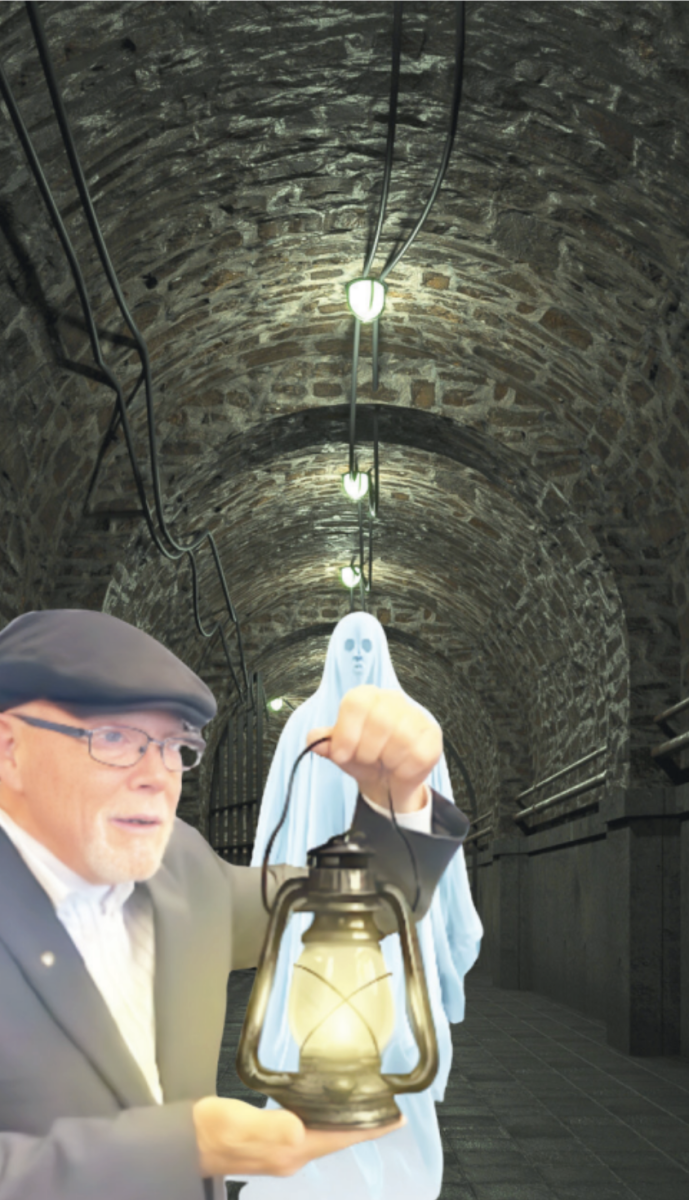
Deep under Loyola Hall, past the building’s basement, lies a secret tunnel system connecting Loyola’s two oldest buildings: Loyola Hall and Rupert Hall. Over the years, these tunnels have sparked countless theories—ranging from secret Jesuit passageways to a post–World War I bunker.
Stewart Hayes, informational lead, offers one possible explanation. “Built because of post–World War I, they were thinking probably access and shelter to other buildings.” Hayes raises a compelling point: Loyola Hall was constructed in the years following WWI, a time when global uncertainty could have influenced architectural decisions. This theory also explains why the tunnels connect Loyola Hall to Rupert Hall—not only would students and faculty need refuge during a potential threat, but so would the priests and residents of Rupert Hall.
Tyler Lancaster, Archivist & Information Resources Clerk, adds another perspective: “When they were built, earthquakes weren’t something you could plan for. So nowadays, you wouldn’t be able to build something like that…” His comment highlights how different priorities and limitations shaped construction during that era.
In the midst of this discussion, Lee Jackson from Loyola’s Science Department passed by and quietly whispered, “Jesuit tunnels.” Lancaster responded jokingly, “We won’t tell him about the secret ones.” The moment only deepens the mystery.
So, are there more tunnels hidden beneath the campus? Are there passageways known only to the Jesuits? Could there be an abandoned WWI shelter below Loyola Hall? The uncertainty creates an undeniable sense of intrigue—no one seems to fully agree on why the tunnels were built or how they’ve been used over time.
For a more definitive answer, one might turn to Jamie Pena, Loyola’s maintenance engineer. Pena sheds light on the reality behind the speculation. When he began working at Loyola in 1978, the tunnels played a crucial role in the school’s heating system. They were used to transport materials needed to maintain the boilers—originally located in Loyola Hall—and to distribute heat throughout campus.
According to Pena, this was their original purpose: carrying steam from Loyola Hall’s boiler rooms to Rupert Hall and the priests’ living quarters as part of a heating system developed in the 1920s.
When asked about the rumors, Pena is quick to dispel the myths. He describes the tunnels as “not a good [comfortable] place to be,” noting that navigating them requires crawling on your knees. Today, with a modern heating system in place (though not always effective, as many classrooms can feel arctic), the tunnels are primarily used for cabling and technological infrastructure.
While the truth may be less dramatic than the legends, the tunnels remain an essential part of Loyola’s infrastructure. Still, Pena only spoke about the tunnels beneath Loyola and Rupert Hall. Given Loyola’s long and layered history, it’s hard not to wonder if other hidden passages exist—waiting beneath our feet, undiscovered.
What other mysteries might Loyola’s campus be hiding?