





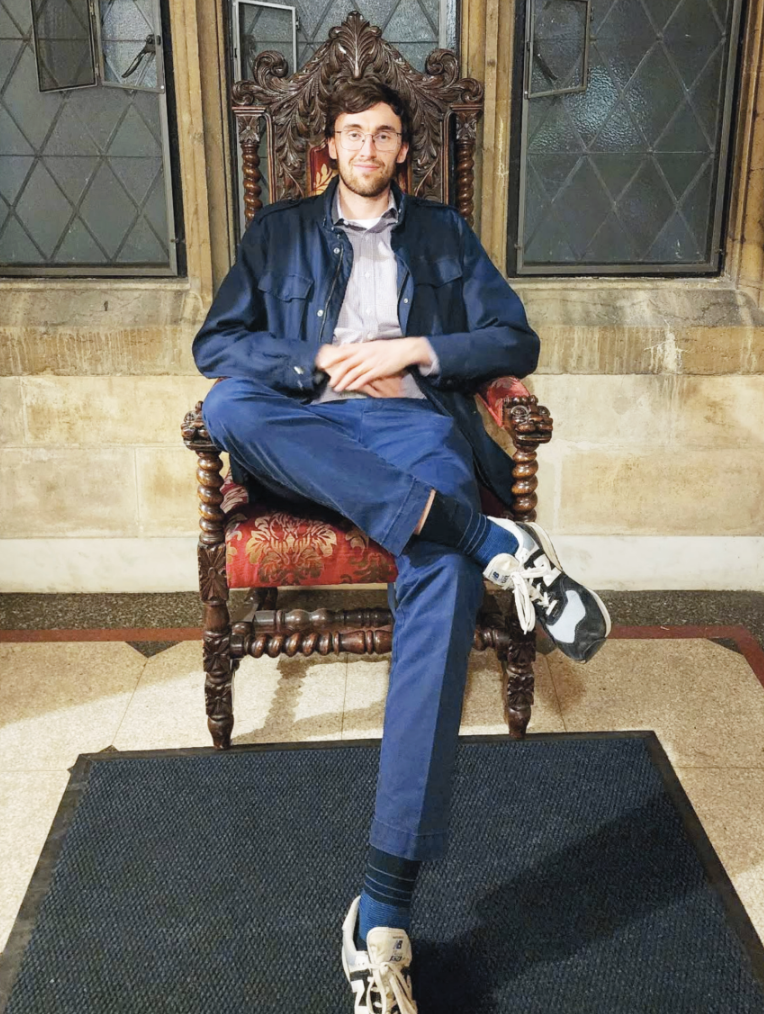
In high school, where grades and tests often feel like the center of learning, Frederick Muth’s ’13 perspective stands out. For him, teaching Latin isn’t just about memorizing grammar charts or translating ancient texts. It is about helping students discover curiosity, discipline and the joy of learning something deeply.
After graduating from Loyola High School in 2013, Magister Muth attended Yale University, majoring in Classics and Classical Languages, Literatures and Linguistics. Following his time at Yale, he worked for Bain & Company, a management consulting firm. While the work was intellectually interesting, he continued to ask himself whether his work was taking away his curiosity and excitement.
“Teaching is different,” Muth said. “It comes with tradeoffs. You make less money, and it takes a lot out of you. You are constantly on, preparing lessons, grading and managing a classroom.”
Despite those challenges, teaching gives him something consulting never could. Muth calls them “moments.”
“These are the occasions when a student gets excited about learning. When they make a connection they didn’t see before. When they tell you, sometimes quietly, that what you are doing matters to them. It is not one big cinematic moment that tells you that you made the right choice. It is a constellation of small interactions that add up over time.”
What’s interesting about Magister Muth is how deliberately he chose this path. He was not someone who fell into teaching because other doors closed. He walked away from a career that most people would envy, one with a clear trajectory, strong pay and intellectual prestige. He made the choice with open eyes. That intentionality seems to carry into how he runs his classroom. He is not just filling time until the bell rings. He is thinking carefully about what his students are actually taking away, not just from the lesson, but from the experience of being in the room.
When people ask whether Latin is a “dead language,” Magister Muth sees the question differently. He points out that most students do not leave high school fluent in the languages they study anyway, especially if they do not continue using them later. The more important question, he says, is what students gain from the experience along the way.
Latin may be a niche subject, but that is part of what makes it powerful. Students often discover that it connects to far more than grammar. It links mythology, Roman history, political ideas and the roots of many modern European languages. Along the way, they also develop important academic skills such as analyzing carefully, thinking structurally, using reference materials and investing real effort in something challenging.
As Magister Muth explained, the goal is not simply memorizing declensions, but learning how to care about something. If students are genuinely curious and engaged in one class, they realize they can bring that same focus to anything they pursue. Despite its reputation, Latin is far from dead. Communities of students across the country continue to study it, compete in academic events and build friendships through organizations like the Junior Classical League.
I concluded my interview with Magister Muth with my standard closing question.
“What do you think is necessary for a good life?”
He reflected for a moment before answering.
“Ancient philosophers often debated what comprises the good life, and clearly that question still lingers for all of us today. I personally think that a good life makes the most of the opportunities that surround us. These include connections with family and friends, the beauty of the natural world and human inventions and exploring enjoyable experiences. That can be tasting delicious foods, devouring enthralling books and other media or trying something new with friends. This world has its challenges for all of us, but I have found that the best things can be found along the way with the right mindset to enjoy what we have in front of us.”
Magister Muth knows that most students will eventually forget the details of Latin grammar. However, he hopes they remember something more important. He hopes they remember the feeling of discovering that learning can be meaningful and exciting.
In our conversation, he returned to a Latin phrase that has guided him for years.
“Omnia disce; videbis postea nihil esse superfluum.”
Learn everything, and later you will see that nothing was unnecessary. It is a reminder that every experience, every subject and every moment of curiosity can shape who we become. If students leave his classroom a little more curious about the world than when they entered, then, in his view, the class has done exactly what it was meant to do.
This enlightening conversation I had was part of a project I started called Humans of Los Angeles, a photoblog inspired by Humans of New York that captures the everyday stories of people across the city. Over the past year and a half, I have interviewed and photographed people throughout the greater Los Angeles region, sometimes people I am acquainted with only a little and sometimes complete strangers willing to share their stories. The project combines my love of storytelling, film and philosophy, and has given me a front row seat to the life experiences, backgrounds and aspirations of people across the city. Follow Humans of Los Angeles on Instagram @humans_of_losangeles_.